
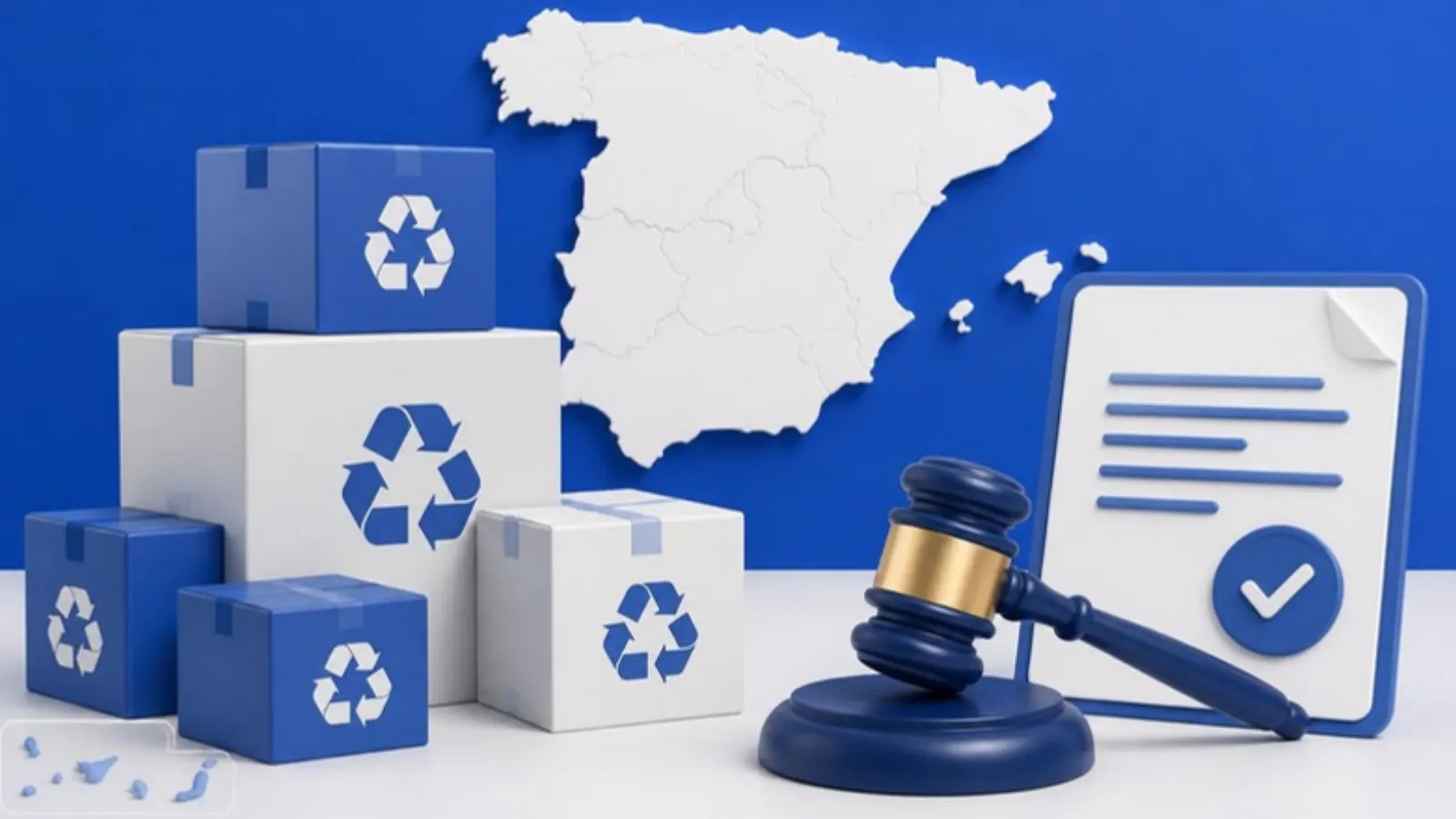
By Operator One Editorial, 14 June 2026
Key takeaways
- Royal Decree 1055/2022 makes every producer placing packaged products on the Spanish market register in the packaging section of MITECO's Registro de Productores de Productos (article 15), which issues a number in the format ENV/year/nine digits.
- Article 16.2 of Royal Decree 1055/2022 requires the annual packaging declaration before 31 March of the following year: 2025 data was due by 31 March 2026, and MITECO's filing window for 2026 data runs from 1 January to 31 March 2027.
- Article 17.2 of Royal Decree 1055/2022 obliges producers established in another EU Member State or a third country to designate an authorised representative in Spain; if they do not, the first distributor established in Spain, or the e-commerce platform on imports from outside Spain, steps in subsidiarily.
- Under articles 108.3.ac and 109 of Law 7/2022, failing to register or report is a serious infringement fined EUR 2,001 to EUR 100,000, and article 12.3.g gives MITECO, not the autonomous communities, the sanctioning power over registry and reporting duties.
- Regulation (EU) 2025/40 (PPWR) has applied since 12 August 2026: article 45(3) requires cross-border distance sellers to appoint an EPR authorised representative, and article 45(4) requires online platforms to collect producers' registration numbers before letting them sell.
- There is no de minimis exemption from Spanish packaging EPR registration, but article 16.1 of Royal Decree 1055/2022 allows a simplified declaration for producers placing under 15 tonnes of packaging a year.
What Royal Decree 1055/2022 actually does
Royal Decree 1055/2022 of 27 December on packaging and packaging waste is Spain's packaging EPR regulation. It entered into force on 29 December 2022 and sits underneath Law 7/2022 of 8 April on waste and contaminated soils for a circular economy. It replaced the older regime, which placed EPR only on household packaging, with a single framework covering household, commercial and industrial packaging, and it brings every producer placing packaged products on the Spanish market, whether a domestic manufacturer, an EU brand or a non-EU seller, into the same Extended Producer Responsibility (EPR) system.
Three dates matter most for cross-border sellers. The new marking obligations in article 13 of Royal Decree 1055/2022 have applied since 1 January 2025 (fifth final provision), and the third transitional provision required producers not previously in a scheme, in practice those placing commercial and industrial packaging, to set up EPR schemes before 31 December 2024. Registration in MITECO's Registro de Productores de Productos is a precondition for placing packaged products on the market. And article 16.2 requires the annual packaging declaration before 31 March of the following year, so 2025 data was due by 31 March 2026. Earlier versions of this article gave 2 April 2026; that date was wrong.
Since 12 August 2026, Regulation (EU) 2025/40 on packaging and packaging waste (PPWR) also applies directly in Spain under its article 71. Royal Decree 1055/2022 remains in force alongside it, and MITECO's electronic office now cites both article 16 of the Royal Decree and article 44 of the PPWR as the basis for the annual declaration.
Who counts as the "producer", and why marketplaces care
Article 2 of Royal Decree 1055/2022 defines the producer of the product as the packer, or the economic operator importing or acquiring packaged products in another EU Member State to place them on the Spanish market. The decree's preamble explains that for primary, secondary and transport packaging used in distance selling, the operator responsible for marketing the products is treated as the packer. A French brand selling packaged goods directly to Spanish consumers is therefore the producer for that packaging in Spain. There is no de minimis exemption from registration, although article 16.1 allows a simplified declaration below 15 tonnes of packaging a year, and article 15.1 moves the registration duty to packaging manufacturers or distributors for producers placing only service packaging and under 50,000 kg of commercial and industrial packaging.
Royal Decree 1055/2022 does not itself oblige marketplaces to verify producers. It makes platforms responsible in two defined cases instead. Under article 2.t, where packaged products from outside Spain enter the market through an e-commerce platform and the producer has not designated an authorised representative, the platform acts subsidiarily as producer for the financial, information and, where relevant, organisational obligations. Under article 17.5, platforms that facilitate a third party's sales carry those obligations for the transport packaging used. The verification duty now comes from EU law: article 45(4) of Regulation (EU) 2025/40 requires online platforms to obtain a producer's registration number in the consumer's Member State, plus a self-certification of EPR compliance, before allowing that producer to use their services.
Ecoembes, Ecovidrio and the collective-scheme route
Producers can comply through an individual scheme, but most join a collective extended producer responsibility scheme (SCRAP, in Spanish). Ecoembes covers household light packaging and paper and cardboard, and since 1 January 2025 its Ecoembes Comerciales scheme, authorised by the Community of Madrid, also covers commercial packaging, with industrial packaging handled through agreements with other schemes. Ecovidrio covers glass. Under article 17.3 of Royal Decree 1055/2022, the scheme discharges the producer's financing, collection and recycling-target obligations, but all other obligations, including registration and declarations, stay with the producer individually.
Registration is a two-part exercise. The producer joins a scheme for each packaging category it places on the market, then registers in the packaging section of MITECO's Registro de Productores de Productos, providing the scheme membership certificate at registration (article 15.2). MITECO assigns a number in the format ENV/year/nine digits, which article 15.3 requires on invoices and other documents accompanying packaged products through the supply chain. Producers established outside Spain must designate an authorised representative in Spanish territory under article 17.2, and that representative can register and report on their behalf.
The fine framework: Law 7/2022, not the RD itself
Royal Decree 1055/2022 sets the obligations; the infringements and sanctions sit in articles 108 and 109 of Law 7/2022. Article 108.3.ac classes failure to register in the Registro de Productores de Productos, to provide the registered producer number, or to report products placed on the Spanish market as a serious infringement. Article 109.1 sets the fine bands:
- Minor: up to EUR 2,000.
- Serious: EUR 2,001 to EUR 100,000, plus possible disqualification from the activity for under one year.
- Very serious: EUR 100,001 to EUR 3,500,000, plus possible disqualification for one to ten years.
Under article 109.2 of Law 7/2022, where the fine would be lower than the benefit obtained from the infringement, it can be raised to double that benefit, even above the statutory maximum. The sanctioning authority depends on the obligation. Article 12.3.g gives MITECO the power of surveillance, inspection and sanction over the registration and information obligations of the Registro de Productores de Productos, so a missing registration or a missed declaration is a matter for the central ministry. The autonomous communities hold sanctioning powers over waste production and management activities.
What brands actually got wrong in year one
The failure modes below reflect Operator One's experience with brands selling into Spain, not official enforcement statistics. None of them is exotic:
- Treating the RD as "Ecoembes only". A scheme membership number is not a registration. Article 15 of Royal Decree 1055/2022 requires a separate inscription in MITECO's register, and the ENV number is the identifier platforms collect under article 45(4) of the PPWR.
- Skipping the authorised representative. Article 17.2 applies to producers established in another EU Member State as well as to non-EU producers. Where none is designated, the first distributor established in Spain becomes subsidiarily responsible, and for packaged products from outside Spain sold through an e-commerce platform, the platform does (article 2.t).
- Counting only the retail box. Royal Decree 1055/2022 covers household, commercial and industrial packaging. Shipping boxes, void fill and pallet wrap belong in the declaration unless article 17.5 shifts the transport packaging to a courier or platform.
- Misreading the marking rules. Article 13.1 of Royal Decree 1055/2022 keeps material identification codes under Decision 97/129/EC voluntary. What article 13.2 makes mandatory is indicating reusability, the deposit-return symbol where applicable and, on household packaging, the fraction or container for disposal. Article 13.3 bans wording such as "respetuoso con el medio ambiente" (environmentally friendly).
- Ignoring channel mix. The Spanish producer obligation covers all packaged products placed on the Spanish market, whether sold through Amazon.es, another marketplace or the brand's own webshop. In Operator One's experience, declarations built only from one marketplace's sales report routinely miss direct-to-consumer volume.
Marketplace verification in practice
The legal basis for marketplace checks is now article 45(4) of Regulation (EU) 2025/40, applicable since 12 August 2026: platforms must collect the producer's registration number for the consumer's Member State before allowing it to sell. Article 44(4) of the PPWR separately bars producers from making packaging available in a Member State where they, or their EPR authorised representative, are not registered. For Spain, that means the MITECO ENV number.
In Operator One's experience, marketplaces ask for the ENV number in their compliance settings, and a lapsed scheme contract or a missing registration can surface as a listing restriction some time after the fact. Building the Spanish registration, scheme renewal and the 31 March declaration into the same compliance calendar as VAT returns is the most stable answer.
What 2026 looks like
The declaration for 2025 packaging closed on 31 March 2026. The next deadline is the declaration for 2026 packaging, which MITECO's electronic office opens from 1 January to 31 March 2027, citing both article 16 of Royal Decree 1055/2022 and article 44 of Regulation (EU) 2025/40.
The PPWR changes the frame from 12 August 2026. Article 45(3) requires producers that sell directly to end users in another Member State to appoint, by written mandate, an authorised representative for EPR in each such Member State, and allows Member States to require the same of producers established in third countries. Article 44(2) requires registration in every Member State where a producer first makes packaging available. Spain's existing article 17.2 rule already went further, so for Spain the practical effect is that the obligation is now anchored in directly applicable EU law as well.
Beyond packaging, Spain's EPR architecture continues to expand. The seventh final provision of Law 7/2022 required EPR regimes for textiles, furniture and non-packaging agricultural plastics to be developed by regulation within three years of the law's entry into force. Article 47 of Royal Decree 1055/2022 requires a mandatory deposit-return system for single-use plastic beverage bottles up to 3 litres, extended to cans and beverage cartons, within two years of MITECO establishing that the separate-collection targets in article 10.4 were missed. Spain's special tax on non-reusable plastic packaging, at EUR 0.45 per kilogram of non-recycled plastic under article 78 of Law 7/2022, is a separate levy on top of EPR.
How to register for packaging EPR in Spain, step by step
- Confirm who the producer is. Check whether you are the packer, importer or intra-EU acquirer placing packaged products on the Spanish market under article 2 of Royal Decree 1055/2022 and article 3(1)(15) of Regulation (EU) 2025/40.
- Appoint a Spanish authorised representative if established elsewhere. Producers established in another EU Member State or a third country designate a representative in Spain with written proof of the mandate, as article 17.2 of Royal Decree 1055/2022 and article 45(3) of the PPWR require.
- Join an EPR scheme for each packaging category. Contract with an individual or collective scheme, for example Ecoembes for household or commercial light packaging or Ecovidrio for glass, and obtain the membership certificate.
- Register in MITECO's Registro de Productores de Productos. Inscribe in the packaging section, upload the scheme certificate and receive the registration number in the format ENV/year/nine digits under article 15 of Royal Decree 1055/2022.
- Use the ENV number on invoices and marketplace accounts. Show the number on invoices accompanying packaged products (article 15.3) and give it to online platforms, which must collect it under article 45(4) of the PPWR.
- Mark household packaging correctly. Indicate the disposal fraction or container, reusability and any deposit-return symbol as article 13.2 of Royal Decree 1055/2022 requires, and avoid claims such as 'respetuoso con el medio ambiente'.
- File the annual declaration by 31 March. Report the previous year's packaging between 1 January and 31 March, using the simplified declaration if you place under 15 tonnes a year (article 16 of Royal Decree 1055/2022).
Frequently asked questions
What is the deadline for Spain's annual packaging declaration under RD 1055/2022?
Article 16.2 of Royal Decree 1055/2022 requires producers registered in the packaging section of Spain's Registro de Productores de Productos to report packaging placed on the market before 31 March of the following year. The 2025 declaration was therefore due by 31 March 2026, not 2 April. MITECO's electronic office sets the window for 2026 data at 1 January to 31 March 2027. A missed declaration is a serious infringement under article 108.3.ac of Law 7/2022.
Do marketplaces need my Spanish EPR registration number?
Yes, from 12 August 2026. Article 45(4) of Regulation (EU) 2025/40 (PPWR) requires online platforms that let consumers conclude distance contracts to obtain, before allowing a producer to use their services, its registration number in the Member State where the consumer is located. For Spain that is the ENV/year/nine-digit number issued by MITECO. An Ecoembes membership reference or a tax number is not the same thing.
Is joining Ecoembes enough to comply with packaging EPR in Spain?
No. Ecoembes (household and, through Ecoembes Comerciales, commercial packaging) and Ecovidrio (glass) are collective schemes that carry the financing and collection obligations. Article 15 of Royal Decree 1055/2022 requires a separate inscription in MITECO's Registro de Productores de Productos, with the scheme membership certificate provided at registration. The ENV number assigned there must appear on invoices accompanying packaged products under article 15.3, and article 17.3 keeps other obligations with the producer individually.
Does a non-Spanish brand need an authorised representative in Spain?
Yes, where the brand is the producer. Article 17.2 of Royal Decree 1055/2022 obliges producers established in another EU Member State or in a third country to designate a natural or legal person in Spain as authorised representative, holding documentary proof of the mandate. If none is appointed, the first distributor established in Spain becomes subsidiarily responsible, and under article 2.t an e-commerce platform steps in for packaged products from outside Spain. PPWR article 45(3) now requires producers selling directly to end users in another Member State to appoint an EPR authorised representative there, and lets Member States extend that duty to all third-country producers.
What happens if a brand ignores Spanish packaging EPR completely?
Article 108.3.ac of Law 7/2022 classes failure to register in the Registro de Productores de Productos, or to report packaging placed on the market, as a serious infringement. Article 109 fines serious infringements at EUR 2,001 to EUR 100,000, very serious ones at EUR 100,001 to EUR 3,500,000 and minor ones up to EUR 2,000, and a fine can rise to double the benefit obtained. From 12 August 2026, PPWR article 44(4) also bars unregistered producers from making packaging available in Spain.
Who carries the EPR obligation in Spain when a Merchant of Record is the seller?
Under article 2 of Royal Decree 1055/2022, the producer is the packer, or the importer or intra-EU acquirer, placing packaged products on the Spanish market. Where a Merchant of Record imports the goods or places them on the market and sells in its own name, it is generally that producer and needs its own ENV registration, which does not transfer from the brand. If the Merchant of Record is not established in Spain, article 17.2 also requires it to appoint a Spanish authorised representative.
Is there a minimum volume below which Spanish packaging EPR does not apply?
No. Royal Decree 1055/2022 sets no de minimis exemption from registration in Spain. Article 16.1 grants a reporting concession only: producers placing under 15 tonnes of packaging a year file a simplified declaration. Article 15.1 moves the registration duty to packaging manufacturers or distributors where a producer places only service packaging plus under 50,000 kg of commercial and industrial packaging. Article 18 adds a five-year prevention and ecodesign plan above thresholds such as 20 tonnes of plastic.
Does Spain's packaging declaration cover the shipping box, or only the retail pack?
Royal Decree 1055/2022 covers household, commercial and industrial packaging in one framework, including primary, secondary and transport packaging. For distance selling, article 17.5 shifts the financial and reporting obligations for transport packaging to the courier or parcel company that supplies it, or to the e-commerce platform where the platform facilitates a third party's sales. Outside those two cases, transport packaging stays with the producer to declare.
Is Spain's plastic packaging tax the same thing as packaging EPR?
No. Spain's special tax on non-reusable plastic packaging is a separate levy created by Law 7/2022, charged at EUR 0.45 per kilogram of non-recycled plastic under article 78. Article 75.f exempts imports and intra-EU acquisitions where the non-recycled plastic in the packaging does not exceed 5 kilograms in a month. Paying the tax does not replace registration under Royal Decree 1055/2022, and fees to Ecoembes or Ecovidrio are owed separately.
Where a Merchant of Record carries the obligation
Spanish packaging EPR follows the operator that places packaged products on the Spanish market, and a registration in MITECO's Registro de Productores de Productos belongs to one legal entity; it does not transfer to another. Where Operator One acts as Merchant of Record, it is the legal seller: it imports the goods or places them on the market and sells them in its own name, with the client shown as the brand and Operator One as the seller. For that packaging, Operator One is generally the producer under article 2 of Royal Decree 1055/2022 and, where it is not established in Spain, article 17.2 requires a Spanish authorised representative. Operator One commonly arranges one as part of onboarding, but not in every market. Packaging the brand places on the Spanish market itself, for example through its own webshop, stays in the brand's own registration and declaration. The compliance glossary defines producer registers, SCRAPs and authorised representatives.
Sources: Royal Decree 1055/2022 (BOE); Law 7/2022 (BOE); Regulation (EU) 2025/40 (EUR-Lex); MITECO electronic office: annual packaging information procedure; MITECO technical document, packaging section of the Registro de Productores de Productos; Ecoembes: Ecoembes Comerciales authorisation.